
Cypress & Devotion in the Desert
Good grief. I started to write this newsletter about a month and a half ago, while still in the high desert. The equinox brought me back to the “Hudson” Valley, and the whirlwind of Spring put this writing on the back burner. I began to fear it was becoming out of date— (“I could be writing about the Nettles and ephemerals instead!”). But when I return to these lessons from the Cypress tree, I trust this medicine still needs woven into this space.

Arizona Cypress branch ripe with needles and resin
𓇢𓆸
In the thick of this past January, amidst the murders of Renée Good and Alex Pretti in Minneapolis, a branch fell from the Cypress tree. This tree, Cupressus arizonica, is native to the lands surrounding the Sonoran and Chihuahuan deserts, ancestral homes of the Tohono O'odham, San Carlos Apache, and the Pascua Yaqui.
Yet Cypress also connects to my cultural ancestry, playing a key role in Greek culture and mythology. The Mediterranean Cypress of lore is the cousin to the Arizona Cypress who now grows beside me, on the high desert land I’ve been enmeshed in this past winter. The hot, dry climates of both the Mediterranean and the Southwest allow for two remarkably similar trees.
The fallen winter branch brings my attention to the tree. I admire the peeling purple-brown bark and noticed the many amber jewels of resin glistening in the evening sun. Normally, conifer trees exude resin to heal a fresh wound, but the Cypress oozes resin abundantly all over their trunk and branches, even when no harm is done.
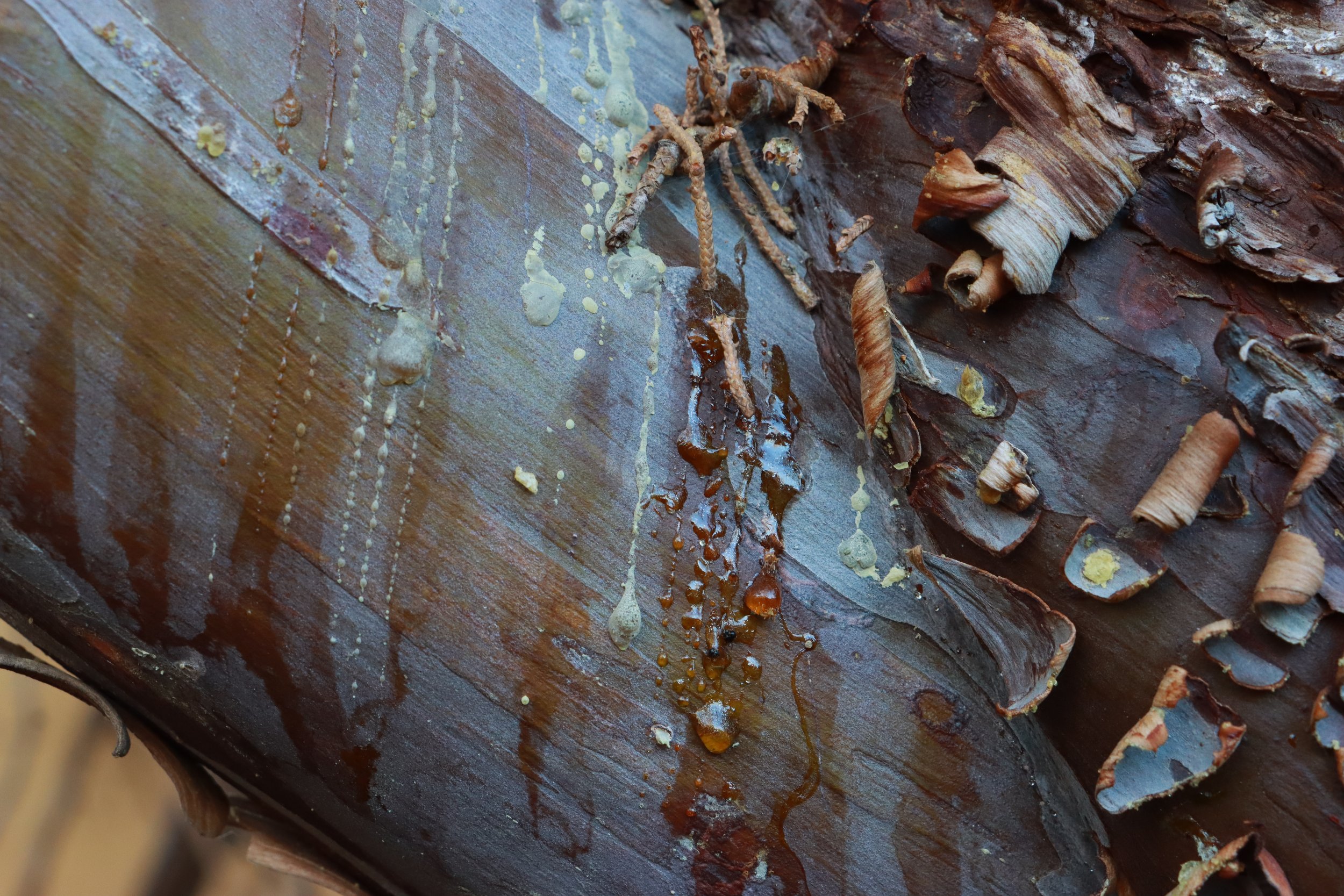
the oozing beauty of Arizona Cypress
In myth, this resin represents the tears of an ever-devoted grief. So traditionally, Cypress was planted near burial grounds and ritual sites to honor the dead; the wood built coffins; and the evergreen aromatics surrounded those mourning, as they burned and carried Cypress branches amidst their heartfelt depths. ¹
All of these practices tie to the myth of Cyparissus, whose body became this tree, and who is now offering this resinous branch of fragrant needles on this January day. I turn to this story as medicine amidst a time of personal and collective grief, as the white supremacist, fascist culture of the “United States” so openly brandishes its power and violence.

Greek mosaic of Cyparissus
Cyparissus, a boy of the island of Ceos, loved dearly a sacred stag of the land. This stag’s antlers shone gold; the nymphs decorated him with jewels; and he was without fear, offering his soft neck even for strangers to stroke. But more than any other, Cyparissus devoted himself to the stag. He led him to the clearest springs and greenest pastures. He wove bright flower garlands for his horns, and at times, with purple reins, he gently rode the stag around the island.
One early summer day, while the sun was in the sign of Cancer, Cyparissus was practicing the throws of his javelin. His beloved stag relaxed in the shade nearby, easy in each other’s presence. Accidentally, Cyparissus’ throw went awry, landing to pierce the stag in the heart. Cyparissus rushed over, threw his arms around the stag’s soft neck, and wept. Soon, Apollo arrived, trying to console this boy that he loved, but Cyparissus only replied with the cry, “May my tears fall forever!” ²
Seeing the depth of his grief, Apollo chose to transform Cyparissus into the Cypress tree. To this day, the boy’s tears fall, witnessed as the tree’s abundant resin.
𓇢𓆸
This story illustrates not only some unfortunate happening or an origin story, but foremost, in my eyes, it is a story of devotion. The latin root of this word,devovere, means to make a vow with one’s whole self, with de- meaning completely and vovere, to vow. Essentially, to be devoted is to sacrifice oneself for a purpose. In Ancient Rome, the term devotio referred to a vow where a General sacrificed his life to the gods to secure victory.³
But Cyparissus’ devotion was not for a military or colonizing state, like in the Roman’s case, but for the stag, who, in Ancient Greece, symbolized the sacredness of the land. In devotion to the stag, Cyparissus gave himself to the beauty and balance of the natural world, both in his life and death.
He left offerings, gave care, and when he caused the stag to leave the realm of the living, he sacrificed himself to a never-ending grief so that he may stay forever devoted. Now, Cyparissus is still connected to his companion as an arboreal limb of the land to which the stag returned. And the stag lives on in memory as we witness the Cypress tree’s abundant, resinous tears. These tears say: in my grief, I maintain my vow to honor the sacredness of the stag, of the land.
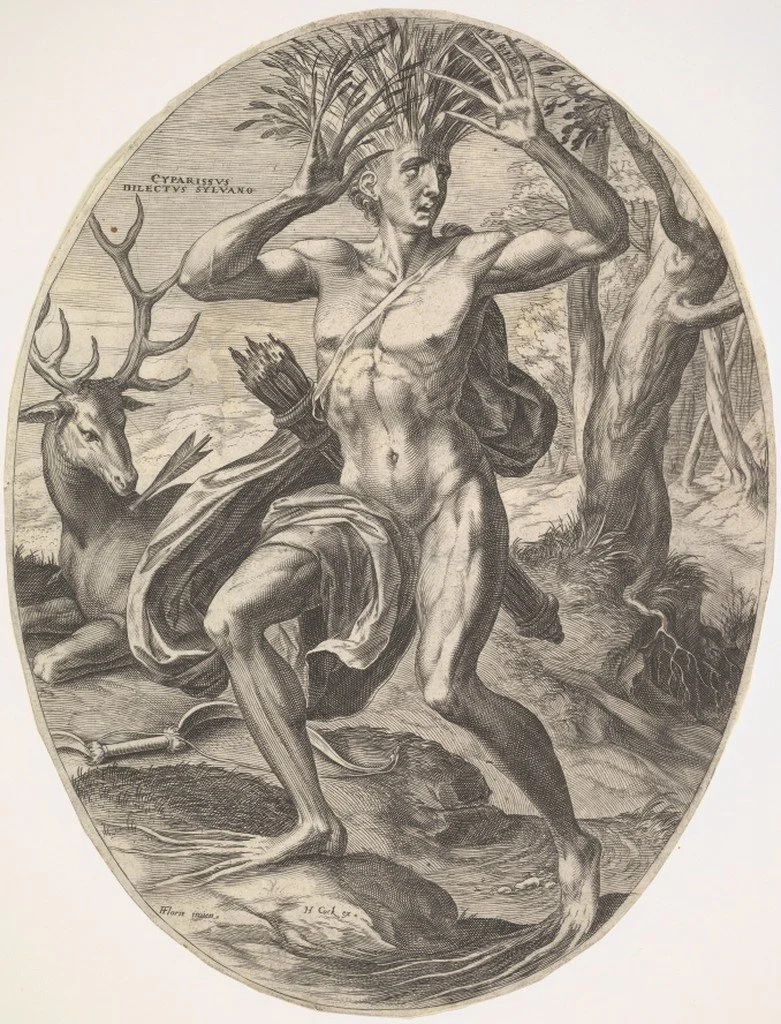
Cornelis Cort, 1565, engraving depicting Cyparissus becoming Cypress
Now, as this Cypress limb falls before me during a time of political and personal unraveling, I turn my view towards devotion. Geraldo Lunas Campos. Keith Porter. Renee Good. Alex Pretti. The immigrants continuing to stay and stand up for their human rights. All of those on ICE watch, protecting their neighbors. Everyone protesting on the front lines.
These are acts of devotion. In some cases, the sacrifice made has been a life.
To acknowledge the inherent dignity of black and brown people in this country and their right to migrate on this land— a continent which is many of their ancestral homelands— is deeply intertwined with acknowledging the inherent dignity of the Earth. This is the intersectionality of liberation. We honor the worthiness of Earth and all of her creatures. And so forth, we recognize that we all have the right to the gift of life and a share of Earth’s resource, beyond ownership.
I see that Cyparissus held this in his heart as well. He made a vow with his whole self to honor the Earth and all her beings. When he breached his vow, he gave his human body and eternal tears as an offering. He gave himself in devotion.
This fallen Cypress branch reminds me to carry this story with me, especially as I honor and grieve all those who have made a vow with their whole selves in the name of a liberatory justice.
I thank the Arizona Cypress before me for their offerings, both storied and tangible. The myth leads to medicine. Cypress: encouraging us to anchor into our devotion; reminding us that grief can also be a way to honor the vows we have made.
May my tears fall forever to water the seeds of liberation we are tending. May we cradle in our hearts what is holy and just without numbing, allowing ourselves to cry— with dignity. May our tears fall like sacred rain in this desert, drought-stricken by an empire we trust will one day disintegrate.
𓇢𓆸
I have a pact with many evergreen trees. When they are a native species and not particularly “weedy” or abundant, I will only wildcraft branches that have fallen but are still vital. There’s a whole nuance to my ethics of wildcrafting as a white person on a Turtle Island, which I plan to dive into in a future newsletter. But for now, this particular pact is relevant, because when I witnessed this fallen Cypress branch, I understood it as an offering for medicine.
I scraped off the resin and stripped the needles to infuse into Jojoba (a plant that’s also native to the Southwest). As that infusion steeped and I enmeshed myself in the mythic sentiments I shared here, I got to experience the magic of a rain in a desert filled with Creosote bushes (Larrea tridenta). I had connected with Creosote before, but I was totally swept away by how their oils diffused through the air after the rain — a scent that’s verdant, smoked, and mineral-rich. As the symbol of tears of grief like desert rain, I felt called by Creosote to harvest a few sprigs of leaves to add into the Cypress oil. Last, at the end of the process, a splash of Juniper Soul was mixed in to offer the support of trust in the unknown.
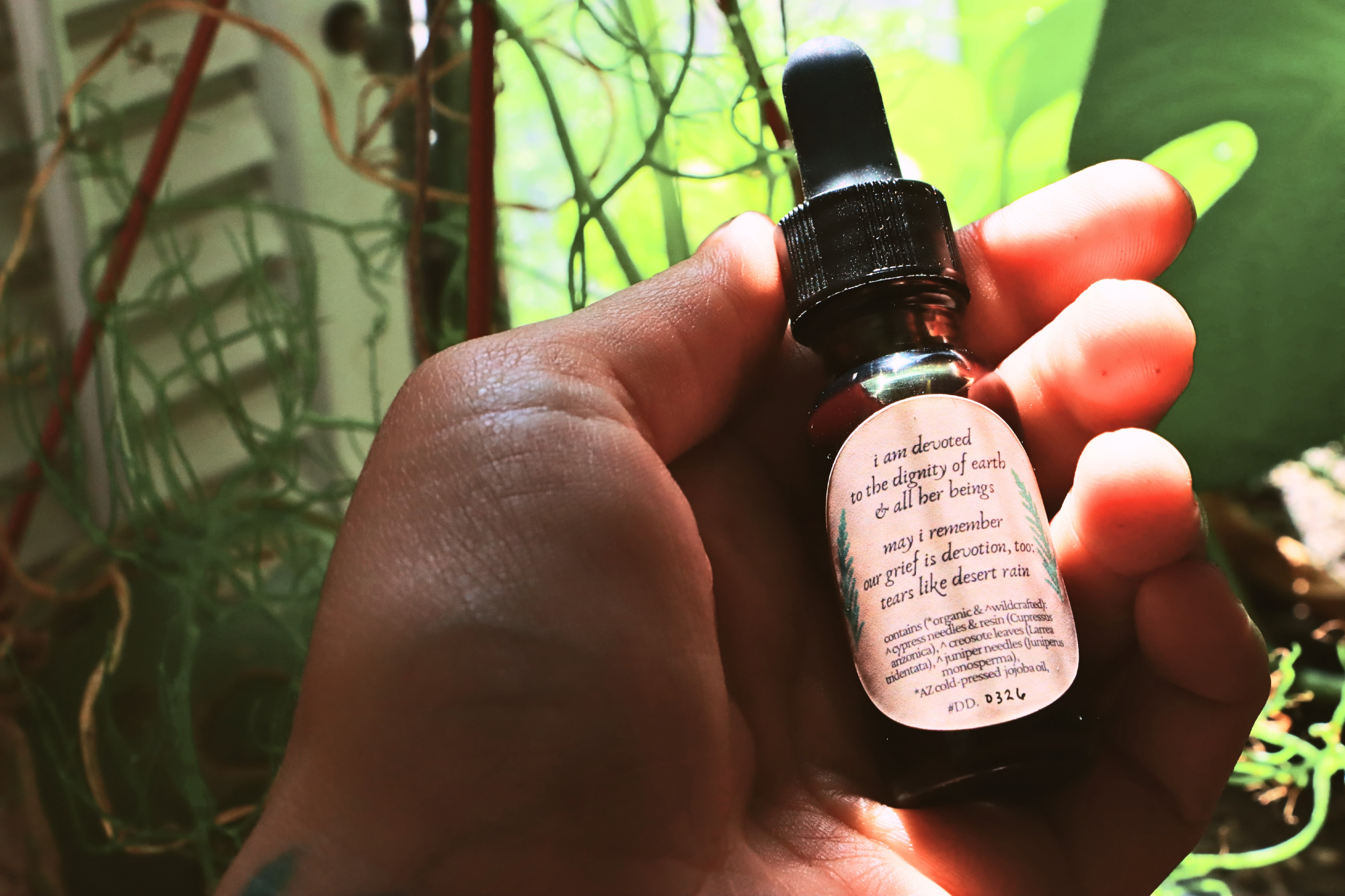
the haiku to recite on the back of the oil’s bottle
This is a very small batch, particularly since a lot of plant material is needed to make an oil very aromatic without any added essential oils. Also, I kept the lion’s share to honor these desert lessons myself and to share with folks on the front lines. The smaller bottle can last though, since you only need a few drops to anchor into the aroma and the practice. Anoint the body (wrists, temples, ears, heart) alongside the haiku on the back of the bottle, or however you feel called.
The scent is smoky, evergreen, earthen, wet. I find it so particular it keeps bringing me back to this practice. May it anchor you in devotion, too.
i am devoted
to the dignity of earth
and all her beings
may i remember
our grief is devotion, too
tears like desert rain
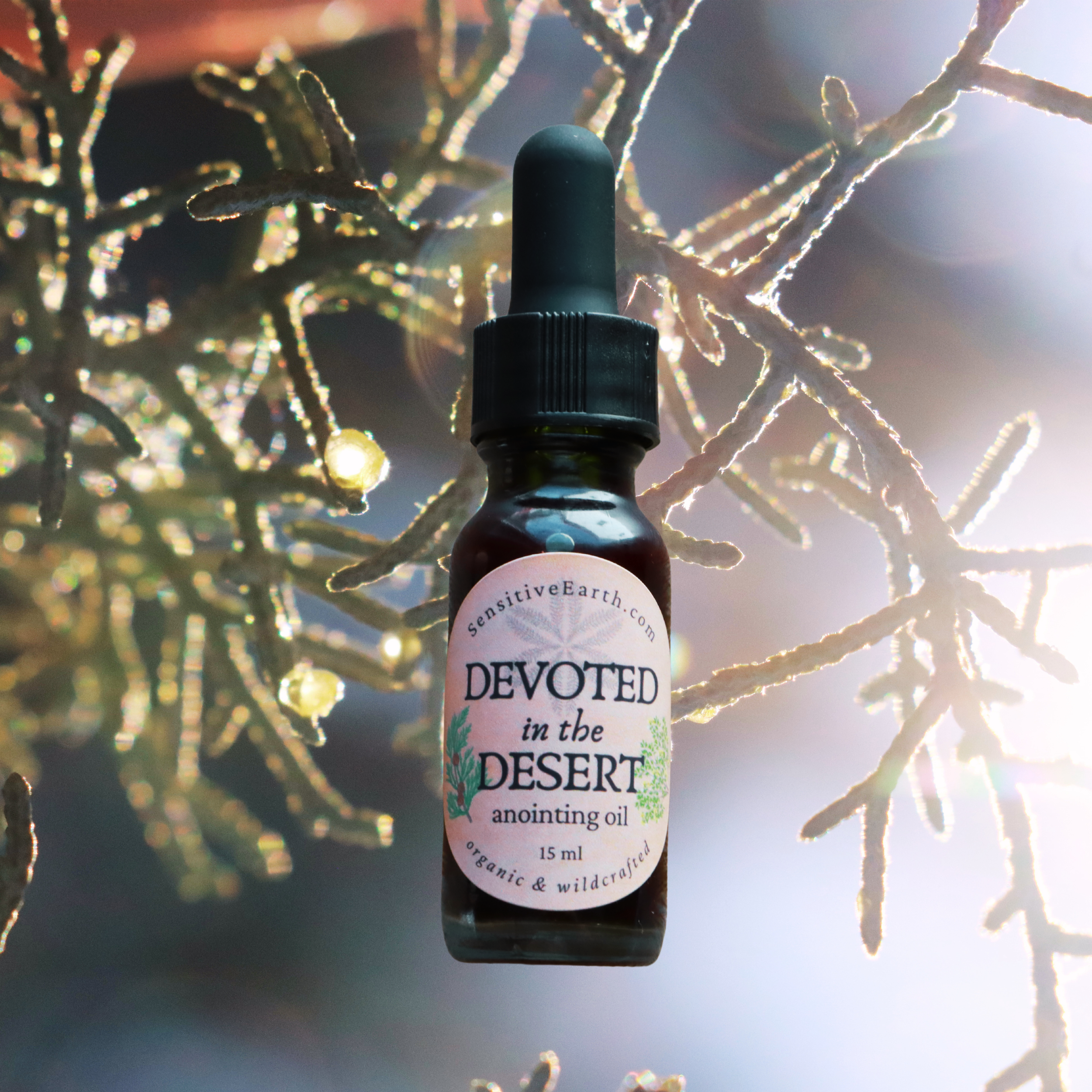
An aromatic oil, ripe with scents of smoke, evergreen, desert rain. No added essential oils: only three wildcrafted plant allies (Cypress, Creosote, Juniper) infused into organic, cold-pressed Arizona jojoba oil. Intended for a ritual devotional practice, reciting the haiku on the back of the bottle.
i am devoted
to the dignity of earth
and all her beings
may i remember
our grief is devotion, too
tears like desert rain
To learn more about the origin story and mythic lessons about this oil, visit this journal post: Cypress and Devotion in the Desert
***
Works Cited
M. Karakitsou on Cypress
Ovid’s Metamorphoses (Book X)
Gaius Stern: Devotio and human sacrifice in archaic Italy and Rome